

You’ve had a facelift. Your jawline appears more defined, your neck smoother, and your facial contours more refreshed. Naturally, one of the next questions becomes: When is it safe to resume Botox?
Botox may be incorporated after facelift surgery once the operating surgeon confirms that healing is sufficiently advanced. Timing, treatment area, and technique should be individualized.
When performed thoughtfully, Botox and facelift surgery are not competing treatments. They address different aspects of facial aging and often work together as part of a long-term maintenance approach.
How Does Botox Interact with Facelift Results?
Botox targets muscle activity rather than surgically repositioned tissues, but its timing and placement during recovery must be individualized. The two treat separate aging mechanisms, structure and tissue position versus dynamic muscle movement.
A facelift addresses structural aging by repositioning deeper facial tissues, including the SMAS layer, fat compartments, and supporting structures affected by gravitational descent over time.
Botox, on the other hand, targets dynamic facial movement. It softens expression-related lines caused by repetitive muscle contraction, such as forehead lines, crow’s feet, and glabellar creasing.
The primary concern after facelift surgery is not whether Botox will interfere with the result, but whether the face has healed enough for treatment planning to be accurate and predictable.
One addresses facial structure and tissue position. The other addresses muscular movement and wrinkle formation.
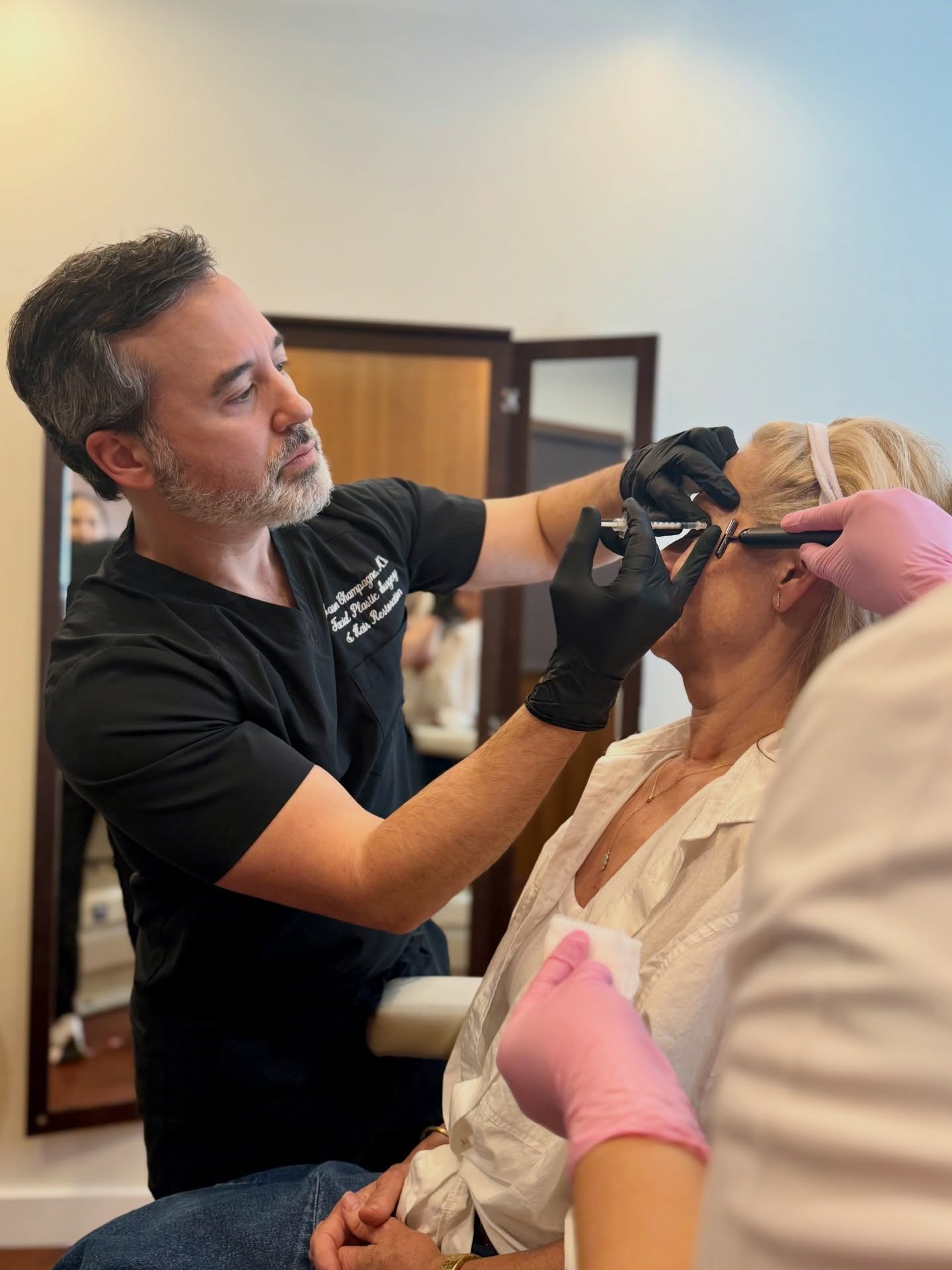
When Can You Get Botox After a Facelift?
Some patients may be evaluated for Botox approximately 6–12 weeks after facelift surgery, but this is not a universal clearance window. The operating surgeon should determine timing based on the procedure performed, the areas being considered for injection, and the patient’s healing progress.
During the early healing phase, swelling continues to evolve, tissues settle gradually, and incision lines mature over time. Injecting too early may lead to less precise dosing or imbalance once swelling fully resolves.
For this reason, Dr. Champagne determines when injectable treatment may resume based on each patient’s postoperative examination. A general facelift recovery timeline can provide context, but the operating surgeon’s instructions take priority.
Why Is Botox Often Deferred During Early Facelift Healing?
Botox is often deferred during the early healing period because swelling and tissue changes can make assessment and dosing less predictable. The appropriate waiting period varies, and exceptions should be determined only by the operating surgeon for a specific patient and indication.
Although much of the visible swelling improves relatively quickly, deeper tissue healing continues beneath the surface. This is not typically the ideal time for Botox treatment.
Patients should first allow their facelift result to stabilize and follow post-operative guidance closely before considering additional cosmetic treatments.
What Determines Whether Botox Can Resume at 6 to 12 Weeks?
A Botox discussion may begin during this period for some patients, but the calendar alone does not establish that treatment is appropriate.
By this stage, many patients have less swelling and more stable facial contours, although healing may still be incomplete.
At this stage, discussion regarding Botox maintenance may become appropriate depending on the patient’s anatomy, healing progress, and goals.
For many patients, the 3-month mark is often considered the ideal window because:
- Swelling has substantially resolved
- Facial positioning is more stable
- Dynamic wrinkles can be evaluated more accurately
- Botox dosing can be tailored more precisely
Why Might Botox Be Considered Around 3 Months After a Facelift?
By around 3 months, many patients have substantially less swelling and more stable facial positioning, which may make dynamic wrinkles easier to evaluate. Some patients need more time, and surgeon clearance remains necessary.
Many facelift patients choose to incorporate Botox as part of a long-term maintenance strategy.
Conservative treatment to areas such as the forehead, glabella, and crow’s feet may help soften repetitive movement and reduce the formation of deeper expression lines over time.
Rather than replacing surgery, Botox often serves as a complementary treatment that helps maintain a refreshed appearance.
Which Areas Should Be Approached Cautiously for Botox After a Facelift?
The glabellar region, forehead, lateral brow, and crow’s-feet area all require individualized assessment because treatment can affect brow and eyelid balance.
No facial area should be assigned an earlier treatment window solely by location; the operative plan, healing progression, anatomy, and intended injection pattern all matter.
Because every facelift is customized differently, timing should always be individualized rather than generalized.
How Does Dr. Champagne Approach Botox for Facelift Patients?
Dr. Champagne uses conservative, precision, placed Botox for facelift patients — focused on refinement, natural movement, and long-term facial harmony.
For facelift patients specifically, treatment is often conservative and strategically placed to preserve natural facial movement while softening unnecessary tension or creasing.
The goal is refinement, not overcorrection.
Instead of creating a frozen or overly treated appearance, Botox is used to support facial harmony and maintain elegant, natural-looking results.
FAQ
Can Botox ruin facelift results?
Botox acts on muscle activity rather than surgically repositioned facial tissues, but treatment during recovery should still be cleared by the operating surgeon. Technique, timing, and injection location can affect facial balance.
Can Botox replace a facelift?
No. Botox can soften selected dynamic wrinkles but does not reposition descended tissue or directly correct jowling, neck laxity, or loss of jawline definition. Those concerns require a separate evaluation and may call for structural or surgical treatment.
How long do facelift results last?
Facelift results may remain visible for years, but longevity varies with anatomy, technique, healing, skin quality, genetics, and ongoing aging. Botox may complement the overall appearance by treating selected dynamic wrinkles, but it does not stop aging or extend the structural effect of a facelift.
Botox may be incorporated after facelift surgery when the operating surgeon confirms that timing, treatment area, and technique are appropriate.
Waiting until the surgeon confirms adequate healing allows the treatment plan to reflect the patient’s more stable postoperative anatomy.


