

A facelift is a specific surgical procedure used to improve visible aging through areas such as the lower face and jawline, with the exact treatment area depending on the technique and patient. Full facial rejuvenation is a broader, customized plan that may combine a facelift with treatment of the neck, eyelids, brow, facial volume, or skin quality.
The important distinction is not “one procedure versus many.” It is whether a patient’s concerns are concentrated in the areas a facelift is designed to treat or distributed across several facial regions.
Some patients may achieve their goals with a facelift alone. Others may benefit from a carefully selected combination. More procedures do not automatically produce a better or more natural result.
Facelift vs. Full Facial Rejuvenation at a Glance
| Question | Facelift | Full Facial Rejuvenation |
|---|---|---|
| What is it? | A defined category of facial surgery | An individualized treatment strategy |
| Primary focus | Commonly the lower face, jowls, jawline and related facial tissue descent | The relationship among the face, neck, eyes, brow, volume and skin |
| Does everyone receive the same treatment? | No; facelift techniques and treatment areas vary | No; the procedures included vary by patient |
| Can it include a neck lift? | It may, depending on the surgical plan and how the practice defines the procedure | It may include a neck lift when the neck contributes to the patient’s concerns |
| Can it address eyelids, brow or skin texture? | Not through the facelift itself | Those areas may be addressed with separate complementary procedures |
| Is more surgery always involved? | Not applicable | No; only procedures with a clear role should be recommended |
| Can treatment be staged? | A facelift may be performed alone | A broader plan may be completed together or staged when appropriate |
What Does a Facelift Treat?
A facelift can improve tissue descent, jowls, and loss of definition through the lower face and jawline. Depending on the technique and anatomy, it may also improve descended cheek tissue and the transition between the face and neck.
“Facelift” does not describe one identical operation. Limited-incision, SMAS, deep plane, and extended techniques differ in how tissues are released and repositioned. The appropriate technique should be selected for the individual rather than chosen because one name is currently more popular.
A facelift does not automatically correct:
- Brow descent
- Excess upper-eyelid skin or lower-eyelid bags
- Facial volume loss
- Skin discoloration, texture, or fine surface lines
- Every form of neck aging
- Chin or jaw projection
Those concerns may require another procedure or may not need treatment at all.
What Is Full Facial Rejuvenation?
Full facial rejuvenation is the planning process used to evaluate several facial areas together. It is not a standardized operation or a fixed package.
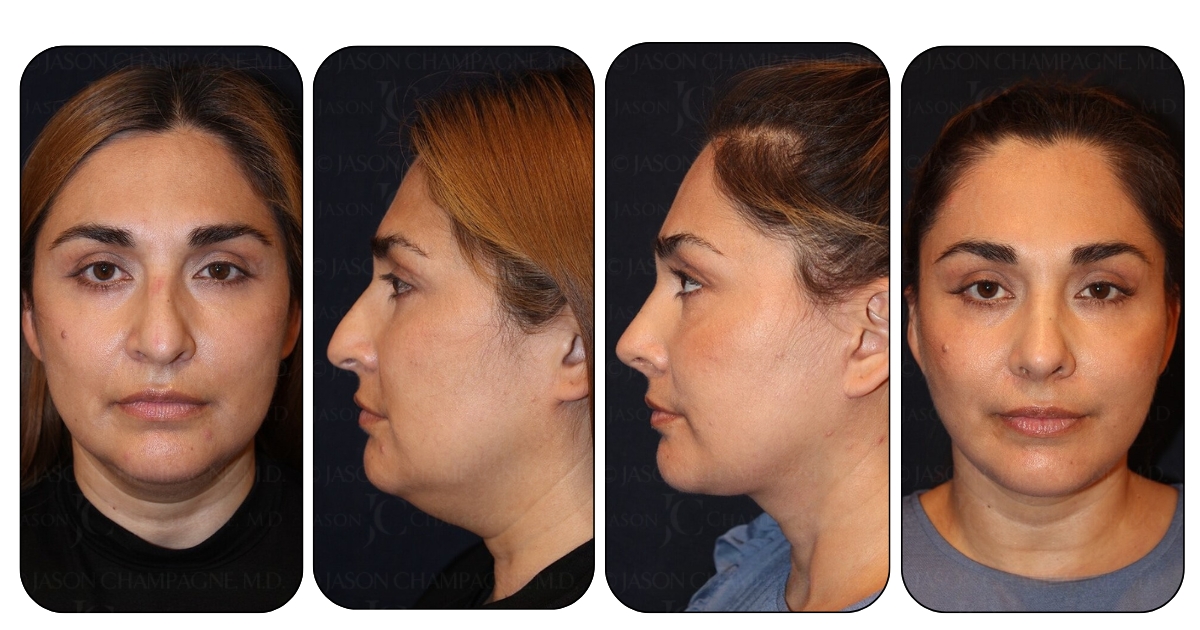
Dr. Jason Champagne’s approach, Champagne Full Facial Rejuvenation®, considers the upper face, midface, lower face, neck, facial volume, skin quality, and overall proportions. Depending on the patient, a plan may include a facelift, neck lift, blepharoplasty, brow lift, facial fat transfer, skin resurfacing, or another complementary procedure.
The purpose of the broader evaluation is not to create a longer list of procedures. It is to determine which concern comes from which anatomical change and whether treating more than one area would improve balance.
When Might a Facelift Alone Be Enough?
A facelift alone may be appropriate when the patient’s primary concerns are concentrated in the areas the selected facelift technique is designed to address.
Examples may include:
- Jowls and reduced jawline definition
- Descent through the lower face
- Cheek changes that the selected technique can reasonably improve
- A face-and-neck relationship that does not require a separate or more extensive neck procedure
- Upper-face, eyelid, volume, and skin concerns that are mild or do not bother the patient
The fact that another feature shows some aging does not mean it needs treatment. If a patient is comfortable with the eyes, brow, skin, and facial volume, adding procedures solely to make the plan “comprehensive” would not be justified.
When Might a Broader Rejuvenation Plan Make Sense?
A broader plan may be considered when concerns involve several areas that a facelift alone cannot address.
For example, a patient may have jowls and lower-face descent along with heavy upper eyelids, lower-eyelid bags, brow descent, volume loss, neck bands, or significant skin-quality concerns. Improving only the lower face may still be worthwhile, but it will not directly correct those separate issues.
A comprehensive plan may help coordinate:
- A neck lift for neck laxity or platysma bands
- Blepharoplasty for selected upper- or lower-eyelid concerns
- A brow lift when brow position contributes to upper-eye heaviness
- Facial fat transfer for selected volume concerns
- Skin resurfacing for texture, pigmentation, or surface lines
- Structural contouring when chin or jaw proportions contribute to facial balance
Each procedure should have a distinct purpose. A combination should never be presented as automatically superior to a focused operation.
Does Full Facial Rejuvenation Look More Natural Than a Facelift?
Not automatically. Natural-looking results depend on appropriate patient selection, sound technique, proportionate correction, healing, and realistic goals.
A well-planned facelift can look natural when it is the right operation for the patient. A multi-procedure plan can also look balanced when each component addresses a genuine concern. Conversely, an overly aggressive combination can look less natural if it changes features the patient wanted to preserve.
The better question is: Which plan addresses the patient’s actual concerns without unnecessary treatment?
Can the Procedures Be Combined in One Surgery?
They may be combined when the patient is a suitable candidate and the total surgical scope is medically appropriate. Combining procedures can coordinate healing and allow the surgeon to plan several areas together.
It can also increase operative time, swelling, bruising, activity restrictions, and the number of risks that need to be considered. Some patients may be better served by a staged plan because of their health, the procedures involved, or personal recovery preferences.
Safety should determine whether treatment is combined—not the desire to complete everything at once.
How Does Recovery Compare?
Recovery after a facelift depends on the technique, treatment area, and individual healing. Recovery after full facial rejuvenation depends on every procedure included.
A broader plan may involve swelling and bruising in more than one facial region, multiple incision sites, additional postoperative instructions, and a longer period before the patient feels ready for work, travel, exercise, or an important event.
That does not mean every combination has a dramatically longer recovery. It means an accurate timeline cannot be provided until the procedures are known. Patients should ask:
- Which areas will be swollen or bruised?
- What help will be needed at home?
- When are follow-up appointments scheduled?
- When may work, travel, exercise, makeup, and social events resume?
- Which symptoms require an urgent call to the practice?
The surgeon’s individualized instructions take priority over general online timelines.
How Do the Risks Compare?
Both approaches involve risk because both may involve surgery. Potential facelift risks can include anesthesia complications, bleeding, infection, fluid collection, delayed healing, scarring, changes in sensation, asymmetry, prolonged swelling, hair loss near incisions, facial nerve weakness, skin injury, or an unsatisfactory cosmetic result.
When other procedures are added, their specific risks must also be considered. The total risk profile depends on the patient’s health, smoking status, surgical history, anatomy, operative plan, and recovery support.
No plan can guarantee a particular result or guarantee that another procedure will never be considered in the future.
How Does Cost Compare?
A facelift and a full facial rejuvenation plan are not interchangeable price categories.
A facelift quote reflects the selected technique, areas treated, complexity, operative time, anesthesia, facility costs, and related care. A full facial rejuvenation quote reflects whichever procedures are actually included. Because the plan is individualized, there is no single price that applies to every patient.
Consultations with Dr. Champagne are fee-based. The consultation fee is nonrefundable and is applied toward surgery if you choose to proceed. This credit is valid for one year from the date of your consultation. The current fee is provided before your appointment is booked. After your evaluation, you will receive a personalized treatment plan and surgical quote.
For a more detailed explanation, read How Much Does a Facelift Cost in Beverly Hills?.
How Does Dr. Champagne Decide Which Approach to Recommend?
Dr. Champagne evaluates the patient’s health history, previous procedures, facial proportions, tissue position, neck, eyelids, brow, volume, skin quality, goals, and the features the patient wants to preserve.
The recommendation should identify:
- The concern the patient sees
- The anatomical change contributing to it
- The procedure designed to address it
- What the procedure will not change
- Whether combining or staging treatment is safer and more appropriate
This framework helps patients compare a focused facelift with a broader plan without assuming that one is universally better.
Frequently Asked Questions
Is full facial rejuvenation a type of facelift?
No. A facelift is a specific category of surgery. Full facial rejuvenation is the broader strategy used to decide whether a facelift alone or a selected combination best addresses the patient’s concerns.
Does full facial rejuvenation always include a facelift?
No. The term describes a comprehensive assessment and personalized plan. A patient’s concerns may be better addressed with other focused treatments, or treatment may be staged.
Does a facelift include a neck lift?
Not automatically. Definitions and surgical plans vary. Patients should ask exactly which face and neck areas are included in the proposed operation and written quote.
Is a deep plane facelift the same as full facial rejuvenation?
No. A deep plane facelift is a facelift technique. Full facial rejuvenation may include a deep plane facelift, another facelift technique, or no facelift, depending on the patient.
Is it safer to stage facial procedures?
It can be for some patients, but there is no universal answer. Health, total operative time, procedure combination, anatomy, and recovery support all influence the recommendation.
Will I look like myself afterward?
The plan should respect the features and proportions the patient wants to preserve. Results and healing vary, and no specific aesthetic outcome can be guaranteed. Reviewing before-and-after photographs and discussing what “natural” means to you are important parts of consultation.
Compare Your Options in Consultation
The choice between a facelift and a broader rejuvenation plan depends on anatomy, priorities, health, recovery considerations, and what the patient does—and does not—want to change.
Explore facelift surgery in Beverly Hills, learn more about Champagne Full Facial Rejuvenation®, view the before-and-after gallery, or request a private consultation.
This article is for general educational purposes and is not a substitute for individualized medical advice. All surgery has risks. Candidacy, procedures, recovery, fees, and results vary by patient.


