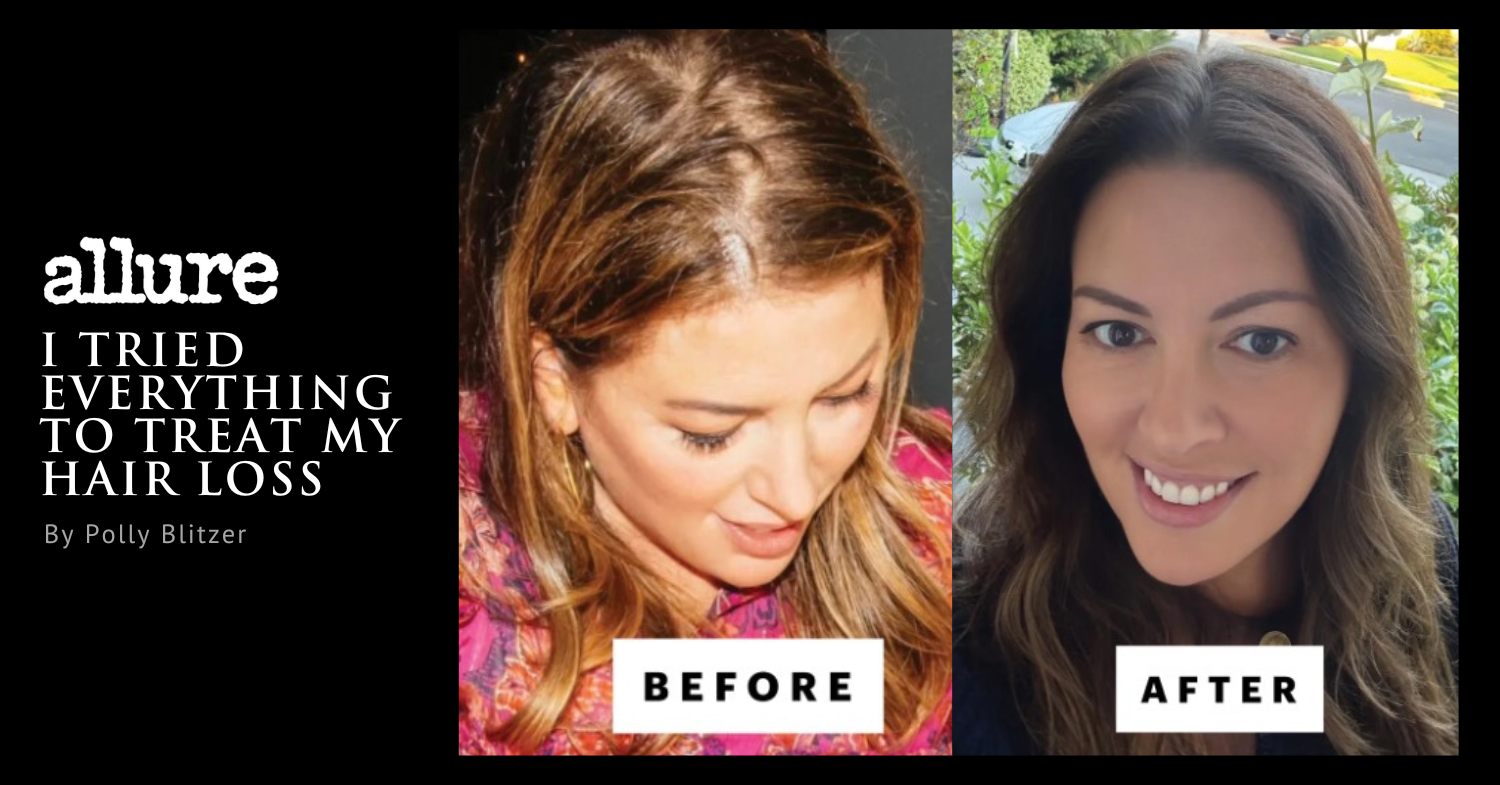
Over the last week alone, I’ve microneedled my hairline, caught up on emails while wearing a four-pound, red-light helmet, and stippled my scalp with mahogany makeup. All to grow—or look like I’ve grown—more hair. I’m not alone. The hair-restoration market (including oral medications, laser treatments, and hair-growth shampoos) reached a staggering $8.77 billion globally in 2023, according to market research company Grand View Research.
As a beauty journalist, I can offer recommendations for the best mascaras without skipping a beat. Struggling with melasma? I’ve got you. Not sure how to handle sudden breakouts? Come sit by me. But when it comes to thinning-hair advice, I’m just as mystified as the next person. I, too, am seduced by the before-and-after ads all over my Instagram feed. I’ve taken all the supplements and used the $100 shampoos. Rinse and repeat.
This personal expenditure of time and money was prompted by an image that’s now seared in my memory. While scrolling through photos from my husband’s birthday party last year, I noticed a balding woman in a dress that looked exactly like mine. It was an overhead view of the crowd. Could this be me? It was. My part had been widening for a year or so, but it was nothing a little dark brown makeup couldn’t fix. I had never seen this bird’s-eye angle: It was clear my temples were receding, too, revealing parabola-shaped patches of scalp. What had happened to my shiny curtains of bouncy hair? Was this a medical problem? Did I need to have my thyroid checked? Many women experience similar changes without realizing how common hair loss in women can be or what treatment options exist. By 70, my grandmother had only a few wisps of blonde cotton candy on her head. I’m in my mid-40s. Maybe this was my genetic fate.
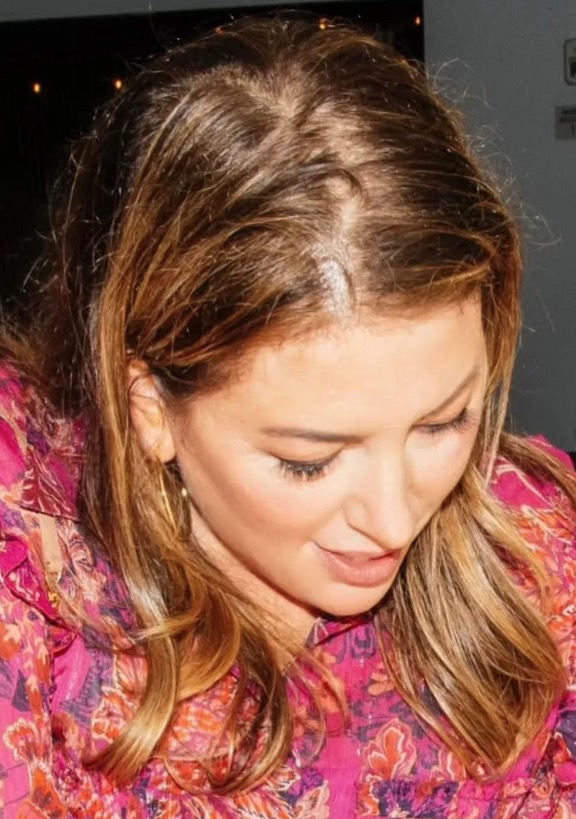
This one hit hard. Even in elementary school, when bullies mocked my buck teeth and glasses, I still won “Best Hair” in a 6th grade poll. Thick, shiny, generally obedient hair has just always been a given for me, the thing that drew compliments and ratcheted up my confidence. I could always rely on a good hair day, no matter what my complexion, waistline, or mood delivered that morning.
A widening part or receding hairline might seem trivial. After all, survival is not dependent on hair. But the emotional impact of losing it can be profound. “Hair loss can be a devastating experience. It can affect a woman’s self-esteem and sense of beauty, femininity, and desirability,” says Greta Angert, a Beverly Hills-based psychotherapist and body-image expert. In fact, studies show a correlation between hair loss and mental health issues like depression and anxiety, particularly in women. “It can be overwhelming and debilitating, leading some women to socially isolate,” Angert adds. Hair is so closely tied to our identity that women will go to great lengths to avoid losing it. Some 8% of cancer patients considered refusing chemotherapy specifically to preserve their hair, according to one study.
Throughout history, a healthy head of hair has been associated with female beauty. Before social media and the Breck girl told us we needed thick, glossy strands, we had Botticelli’s Venus and Rapunzel setting the beauty standard. The societal pressure dates back to biblical times. The phrase “crowning glory” comes from a verse in Corinthians: “If a woman has long hair, it is a glory unto her.”
As much as I wanted to rise above these millennia of beauty standards, I was gutted to see my once-glorious hair go poof before my eyes. So I decided it was time to untangle the mystery of my thinning hair and find where the prevailing research is leading us. After interviewing doctors and meeting with specialists, I got a lot of answers to my many, many questions.
Some in-office lasers can tackle hair loss and some of the newer treatments don’t involve pain or downtime.
The AlmaTED device emits ultrasound waves to stimulate the scalp while using air pressure to open up hair follicle channels. “Once those channels are open, you can apply a cocktail of growth factors, peptides, and antioxidants that can help stimulate the hair growth cycle,” says Beverly Hills-based, double board-certified plastic surgeon and hair-restoration surgeon Jason Champagne, MD. His patients typically notice the results after three monthly treatments, at $1,000 to $1,500 a pop.
Some doctors are injecting actives directly into the scalp. Dr. Champagne reports that his patients have seen an improvement in hair growth and thickness when Botox is injected into the thin muscles surrounding the scalp. One small study published in 2017 found the same result, though much more research is needed. In theory, relaxing these muscles improves blood flow throughout the area and increases oxygen and nutrient levels around hair roots. Dr. Bhanusali injects a steroid, like Kenalog, into the scalp for patients with telogen effluvium or inflammation. “Especially with my post-pregnancy patients who have a propensity to lose a lot of hair, I like to do Kenalog in very small amounts and add LED red light because of the anti-inflammatory aspects. There’s some debate over whether telogen effluvium is actually inflammatory and I think it is because the patients seem to do pretty well,” he says.
A hair transplant can be effective, but it’s not a one-and-done solution.
I’m optimistic about my current hair-loss treatment regimen, but that doesn’t mean I’m not also thinking about what future treatment might look like if I need it. The hair-loss brain trust I tapped into for this story told me that if you’ve tried a combination of minoxidil, spironolactone, or finasteride, and red-light therapy for at least a year and see no improvement, it might be worth considering surgical intervention. In hair-restoration surgery, active follicles are moved from the back of the scalp to areas where the hair is thinning. Even after the surgery, though, you need to be diligent with a maintenance program. Dr. Champagne encourages his patients to continue oral medications like spironolactone, in-office laser treatments, and red-light therapy to keep transplanted hairs healthy. “If you have weak hair, those follicles may not survive the transplantation process because we’re taking them away from their blood supply where they’re happily living and putting them in a new environment,” he says. It’s also worth noting that if your hair loss is due to androgenetic alopecia, you might continue to lose hair even after it’s transplanted, so you should come up with a long-term plan with your doctor. “I like to involve the dermatologist early on because I don’t treat medical causes of hair loss. I’m a hair restoration surgeon for patients who have already seen dermatologists and have already done the preemptive work,” says Dr. Champagne.
Unlike early surgical techniques, today’s hair transplants don’t involve stitches. Follicles are harvested in groups of one to three hairs at a time. A circular blade cuts out 1 mm. sections of scalp (about the size of a sharp pencil point); tweezers are used to remove the tiny graft. The follicles are then separated and implanted in the new site. The procedure is typically performed under local anesthesia and you can return to work in as little as 48 hours. But there’s an art to getting it right.
“We all have cowlicks and areas where the hair grows in different directions. I’m making sure that each hair is turned in the right direction in my recipient sites and that each hair will grow in the flow of the natural hair growth pattern,” adds Dr. Champagne. Earlier hair transplant surgeries were less refined. Doctors either surgically cut out strips of scalp and sewed them into a new area, or they removed a graft of hair the size of a pencil eraser (the equivalent of 20-30 hairs) using a hole-punching tool and stitched each plug into a new location. The result looked like unnatural doll hair with telltale chunky tufts. Those surgeries were painful and the results were unpredictable.
Before you commit to a transplant surgeon, make sure you see their before-and-afters for patients with your hair type, especially photos taken a year after the procedure when final results should be on full display. lf you have curly or textured hair, follicle extraction can be tricky. The hair curls both above the scalp and below its surface, making it more challenging to harvest and transplant. “It’s important to have an understanding of the hair type and how it grows in the scalp because you obviously can’t see a curl below the skin with the naked eye,” says Dr. Champagne. “Otherwise, you’re going to cut across the root and damage that follicle, which is wasting the follicle.”
A note of cosmetic caution: The donor area needs to be completely shaved down, so be prepared for awkward regrowth. (This isn’t usually an issue for men with short hair. It would be for me.) Also, your newly implanted hairs don’t stick around for very long. They usually fall out two weeks after the procedure, which is totally normal.
Exosomes could help—but they’re not all created equal or without risk.
Exosomes—a type of molecule found in nearly all cells that helps transmit messages between them—have been at the forefront of regenerative medicine for a few years. Exosomes can be derived from different sources, like a patient’s own body, tissue from other humans and animals, or plants, and they can be trained to deliver all sorts of messages to the body. In the case of hair growth, they can switch on a phase of the hair-growth cycle, speed up scalp healing, or tell healthy cells to regenerate. “Exosome therapy is working really well for a lot of my patients, who have seen significant thickening of their hair after treatment,” says Dr. Champagne. “By injecting exosomes into the scalp, we are able to reverse dormant hair in the telogen phase back to the healthier anagen growth phase.”
While some research has shown that exosome therapy can be effective in treating alopecia, the medical community isn’t all in just yet. Of the five doctors I spoke with, Dr. Champagne is the only one administering it in his practice.
Commitment is key.
By all accounts, the secret to getting the best head of hair for your buck is daily diligence. My new hair-restoration routine is now more elaborate than a Gen Alpha #GRWM TikTok. It involves swallowing two pills every morning; massaging a clear, watery serum into my scalp twice a day when it feels itchy; lathering my scalp (but not hair) with a red maple syrup-like shampoo twice a week and walking around my house on a daily basis in a stormtrooper helmet. And I can’t slack off—even in response to positive results. “People need to understand that hair loss is a disease. If you stop treatment, the hair is going to slowly fall out again because we haven’t changed your genes. This is your underlying genetic makeup,” cautions Dr. Grossman. “You need to be growing hair like taking care of a garden. You have to water your garden regularly and then you need to fertilize it intermittently.